
‘America’s Most Powerful Transphobe’: How One Man Quietly Shaped Anti-Trans Legislation Nationwide
Matt Sharp is behind anti-trans bathroom, sports, forced outing, and birth certificate laws. He’s testified before more state legislatures than Riley Gaines. And no one’s heard of him.

Over the past 5 years, as Republicans have passed an increasing amount of anti-trans laws, it’s become clear that, when it comes to the definitions and wording used, these laws are largely copies of one another. Ohio’s gender-affirming care ban reads similar to South Carolina’s, South Dakota’s bathroom law looks just like Wyoming’s, and the sports laws in Oklahoma and Iowa are nearly identical.
Of course, all of these laws had to start somewhere. When it comes to trans sports laws, this starting point was Idaho’s 2020 HB 500, and likewise, gender-affirming care bans all stem from 2021 Arkansas law HB 1570. The same also goes for bathroom laws and the since-repealed 2016 North Carolina HB 2, as well as birth certificate laws and 2020 Idaho HB 509.
However, aside from the overarching transphobia, these ‘prime’ laws don’t appear to share much. After all, they’re geographically spread out, cover a few loosely related topics, and vary wildly in enforcement mechanisms. But they do have one thing in common: the Alliance Defending Freedom (ADF), which, for those unfamiliar, is essentially the right-wing, Christian version of the ACLU.
This story starts over a decade ago. In late 2014, the ADF—looking to pivot towards attacking trans people following losses over same-sex marriage—crafted a ‘model’ bathroom bill that put restrictions on trans students. As part of this effort, the ADF began sending it to school districts, offering those who implemented it free legal representation if challenged. The next year, that same policy was incorporated into bills in Colorado, Minnesota, Nevada, and other states, all of which failed, as did similar bills in states like Kansas, South Carolina, and Tennessee in 2016.
However, that year, one did succeed: North Carolina’s infamous HB 2. While HB 2 was much broader than the ADF’s school-focused model legislation, as outlined in this analysis by Mother Jones, HB 2 evidently borrowed heavily from the ADF’s work—using similar language, definitions, and structure. That said, unlike the model, HB 2 did defer the definition of sex to mean what is stated on someone’s birth certificate instead of “a person’s chromosomes”; this detail will be important a bit later.
In the aftermath of HB 2’s passage, the Southern Poverty Law Center (SPLC) designated the ADF as an anti-LGBTQ+ hate group. Moreover, public backlash to the bathroom law resulted in an electoral defeat for North Carolina’s sitting Republican governor, Pat McCrory, and the law was eventually repealed in 2017 by McCrory’s successor, Democrat Roy Cooper. Following that fiasco, no other state was willing to entertain the idea of a bathroom ban. Things quieted down.
At least until Idaho state legislator Barbara Ehardt came knocking. Appointed to the state House in late 2017, Ehardt, a former high school and college coach, made it a priority to come up with a bill to ban trans people from sports—except she wasn’t sure if it was even possible for her state’s legislature to write a law governing that. As she told the Daily Montanan, she reached out to 12–15 conservative groups aligned with “traditional family values” for help.
One group took interest: the ADF, which worked closely with Ehardt to create the bill that became HB 500. And after HB 500 passed in 2020, the ADF appropriated it into a model sports bill and began sending it to Republicans in other states.
The next year, a version of the ADF’s bill passed in Arkansas, Florida, Mississippi, Montana, and West Virginia, with bills inspired by it being passed in Alabama, Tennessee, and Texas. Half a decade later, a total of 27 states have passed at least one sports bill. Given that Alabama and Tennessee have since updated their laws to resemble the ADF model, only two states with sports bans—Texas and Missouri, which modeled its law after Texas’—do not currently have a version of the ADF’s work on the books. Identical bills have also been proposed in nearly every other state.
Ehardt herself went on to support these bills by giving testimony to state legislatures in Kansas, Montana, North Dakota, and Ohio. Additionally, two of these laws, Idaho’s and West Virginia’s, are currently being litigated at the Supreme Court; ADF lawyers are actively assisting both states in these cases. Ehardt also filed an amicus brief to the Supreme Court defending the law.
It isn’t just sports, either. As was revealed in emails leaked by the late Elisa Rae Shupe, in 2020, the ADF also assisted another Idaho legislator—Julianne Young—in writing HB 509, a categorical ban on trans people amending their birth certificates. Up until that point, the ADF had refused to confirm its involvement in drafting that legislation. While 6 other states have since borrowed from this idea, most of those laws have used a different, broader model bill drafted by the far-right organization Independent Women’s Voice.
The next year, the ADF continued its anti-trans campaign, this time in Arkansas. There, while it didn’t write HB 1570 directly—that was largely handled by state representative Robin Lundstrum and the Family Policy Alliance, another conservative group—the ADF contributed towards the bill in a few meaningful ways.
First and foremost, it’s important to note that the bill was an expanded version of 2020 South Dakota bill HB 1057. That bill, which ultimately failed, aimed to ban gender-affirming care for those under 16. However, emails leaked by Shupe revealed that the ADF was involved with its drafting and that one of the group’s attorneys pushed the bill’s sponsor, Fred Deutsch, to raise the minimum age to 18. While Deutsch didn’t end up implementing that suggestion, the new age line was incorporated into the model bill that emerged from HB 1057, the “Vulnerable Child Protection Act” (VCPA).
Aside from these contributions, as stated by federal judge James Maxwell Moody Jr. in his 2023 ruling against Arkansas’ law, the ADF has also recruited a large number of anti-trans medical ‘experts’ that are willing to testify before courts and state legislatures and lend credibility to restrictions on gender-affirming care for minors.
This has had devastating consequences on trans youth nationwide. Currently, 23 states have bans on gender-affirming care for minors in place, and 3 more at least partially restrict it. Moreover, all but 5 of those laws were modeled after the VCPA, and last month, the House also passed a version of the bill. Laws banning gender-affirming care were upheld by the Supreme Court last summer, and as part of that case, the ADF filed an amicus brief in support of Tennessee’s law.
Furthermore, the same year that Arkansas restricted gender-affirming care, Tennessee Republicans decided the time was right to revisit bathroom restrictions. Drawing heavily from the ADF’s model and North Carolina’s HB 2, they passed HB 1233, a narrower law that, just like the ADF originally advocated for, only applies to schools. Over the next two years, Alabama, Arkansas, Idaho, Iowa, Kentucky, and Oklahoma all passed bans that relied on the ADF model.
When this bathroom craze reached Florida, the state’s law, HB 1521, was broadened to include all government buildings as well as a criminalization provision. While it still reads similarly to previous bills in other states, HB 1521 did away with the mention of birth certificates and opted for a more ‘biological’ definition. With two exceptions, all bathroom bills passed after Florida’s include this definition, as the wording makes these laws more difficult to get around.
Now, the number of states that at least partially restrict trans people’s bathroom use has risen to 20. And the language employed by all these laws—except North Dakota’s relatively barebones HB 1144—can be traced back to the ADF.
Finally, the ADF has also focused heavily on promoting bills that ban teachers from affirming their trans students’ names or pronouns without parental consent. These laws, also known as ‘forced outing’ laws, are a cornerstone in conservative fearmongering about schools ‘transing’ kids and can be traced back to a provision that was tacked onto Alabama’s 2022 gender-affirming care ban, SB 184. When that law was challenged, the ADF joined Alabama in defending it.
Then, in 2023, the ADF returned to Arkansas to develop a forced outing law of its own, going as far as physically assisting the bill’s sponsor during its unveiling to the state legislature. That bill’s language would make its way into Idaho’s law the following year. Around the same time, South Carolina passed a law similar to SB 184.
But there’s more to this story. As it turns out, these bills aren’t just largely the work of one organization; they’re largely the work of one man: Matt Sharp.
If you haven’t heard of Sharp, you’re not alone. Aside from his work as an ADF attorney, very little is known about him—he rarely makes public appearances, and when he does, he shares little about his personal life. And most importantly, he never speaks about his central role in shaping the current legal landscape for trans Americans.
Sharp has been a constant since the very beginning. Going back to 2014, as the ADF started shifting towards a more “proactive” role in US policymaking, it assigned three men to oversee its efforts to restrict trans people’s bathroom use: Jeremy Tedesco, Rory Gray, and Matt Sharp. Going by their respective job descriptions at the time, under this arrangement, Tedesco reached out and coordinated with schools, Gray provided potential litigation strategies, and Sharp—then a more low-level attorney within the ADF—handled the legal aspects of the policy itself.
And as the ADF’s model bill made its way into state legislatures, so did Sharp: in February 2016, he testified in favor of South Dakota bathroom bill HB 1008, which passed both chambers before being vetoed by the state’s governor at the time. The following month, he again testified in support of a similar law in Tennessee, HB 2414. According to a video of the hearing (timestamp 1:14:15), Sharp was personally invited by the bill’s sponsor. He also testified in support of a South Carolina bathroom bill in April and made a handful of media appearances criticizing trans students’ bathroom use.
By mid-2017, Sharp had been given full control of the ADF’s bathroom push and was additionally promoted to Senior Counsel. During this time, the model legislation was also updated to include the previously mentioned language pointing to birth certificates as well as an exceptions clause, both of which would go on to become mainstays in bathroom laws some years later.
Similarly, Sharp’s involvement with trans sports legislation started in 2016, and that year, he delivered testimony in support of a failed South Dakota sports ban. But despite that setback, Sharp was unwilling to give up on the issue. Thus, when Barbara Ehardt needed help to develop her own sports bill, it wasn’t just any ADF attorney that answered her call—it was Matt Sharp, who, by that point, had been promoted to being the national director of the ADF’s state government relations.
For two years, Ehardt ‘consulted’ with Sharp as they worked together to craft HB 500; as covered earlier, that bill became the basis for the ADF’s model legislation. And as a result, when sports bills began spreading to other states, Sharp was quick to throw his weight behind them, testifying in favor of sports bills in Arizona, Arkansas, Georgia (twice), Indiana, Kansas, Montana, North Dakota, and Ohio. He additionally influenced the sponsors of the latter bill to change the definition of sex to be ‘biological’ instead of tied to birth certificates. Sharp was also the ADF attorney who assisted Julianne Young with writing the Idaho law that prohibits trans people’s birth certificate amendments.
His involvement doesn’t end there. While not behind the text of gender-affirming care bans themselves, Sharp still contributed heavily to their passage. In Louisiana, Sharp introduced the state’s law—HB 648—alongside the bill’s sponsor and testified in favor of it. He has also delivered testimony supporting the gender-affirming care laws in Kentucky, Ohio, South Carolina, and West Virginia.
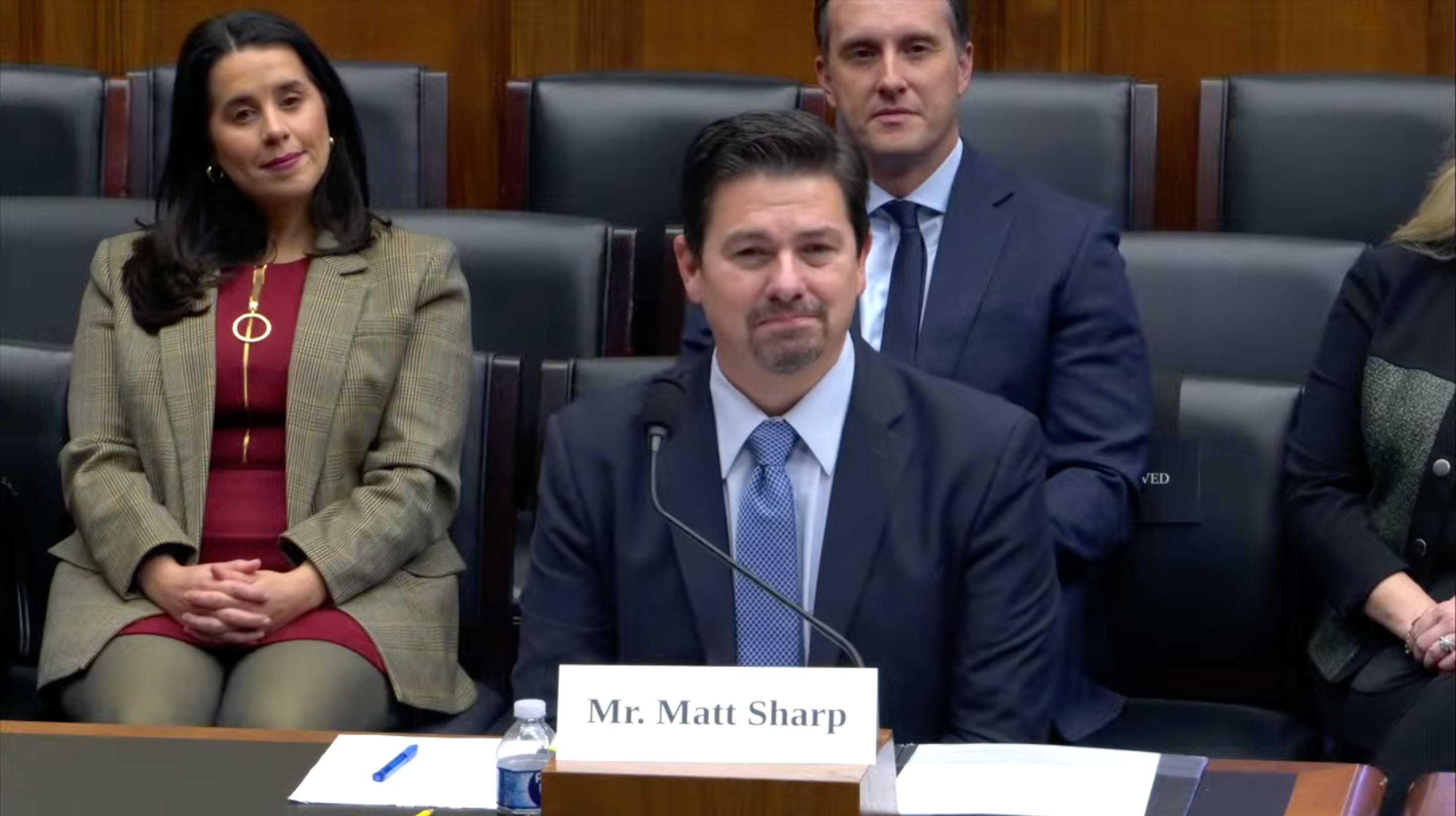
Lastly, Sharp has also focused on laws encouraging the misgendering and deadnaming of trans kids; in fact, it was Sharp who helped unveil Arkansas’ aforementioned forced outing law alongside its sponsor. Aside from testifying in favor of that bill, Sharp has also lent his support to laws allowing teachers to misgender trans students in Kansas and Wyoming. Then, in December 2025, Sharp—now the director of the ADF’s Center for Public Policy—took this attack even further, appearing before Congress to criticize “school districts’ secret social transition policies.”
Sharp had previously delivered testimony to Congress in 2023, that time against the Equality Act. As part of this, he submitted a 22-page document advocating for laws restricting trans people’s healthcare, bathroom use, and participation in sports, opposing same-sex marriage, and pushing forced outing policies.
And yet, despite all of his support for bills restricting trans students’ pronoun and name usage, he doesn’t hold himself to that same standard. As it turns out, his name is actually John Matthew Sharp—Matt is just his preferred name.
There’s a fundamental difference between having influence and having power. When it comes to the rise of transphobia in the United States, Chloe Cole, Donald Trump, Payton McNabb, Riley Gaines, and Ron DeSantis have been among the most influential, building the narrative that has defined many trans Americans’ lives in the past few years. Those with influence tout the ‘family values’ and ‘common sense’ they’ve upheld, the bills and orders they’ve signed, and the ‘impact’ they’ve had in combating ‘progressive gender ideology.’
Matt Sharp doesn’t have influence. He doesn’t appear in political ads, he doesn’t brag about having ‘saved women’s sports,’ and he doesn’t get recognized on the street. But none of that is power.
Those who have power know that they have it. They know how they’ve used it. They know who they’ve hurt. And they don’t flaunt it. For over a decade, Sharp has quietly shaped the laws that have affected countless trans Americans. For over a decade, he’s been able to read headlines about anti-trans laws and instantly know he’s responsible.
That makes him powerful.
But Sharp has something more. Because, for over a decade, he’s been able to look those he’s hurt in the eye without them knowing who he is. Without them having any idea of just how much he’s hurt them.
And that? That makes Matt Sharp America’s most powerful transphobe.
So the dude has something he’s hiding?
Hhmmm. Whats HE hiding?