
The Trump Administration is Testing Conversion Therapy By Medically Experimenting on Trans People in Prisons
The Bureau of Prisons is subjecting trans people to conversion therapy and denying them care with the goal of helping them "recover." It's trying to prove dangerous conversion practices can work.

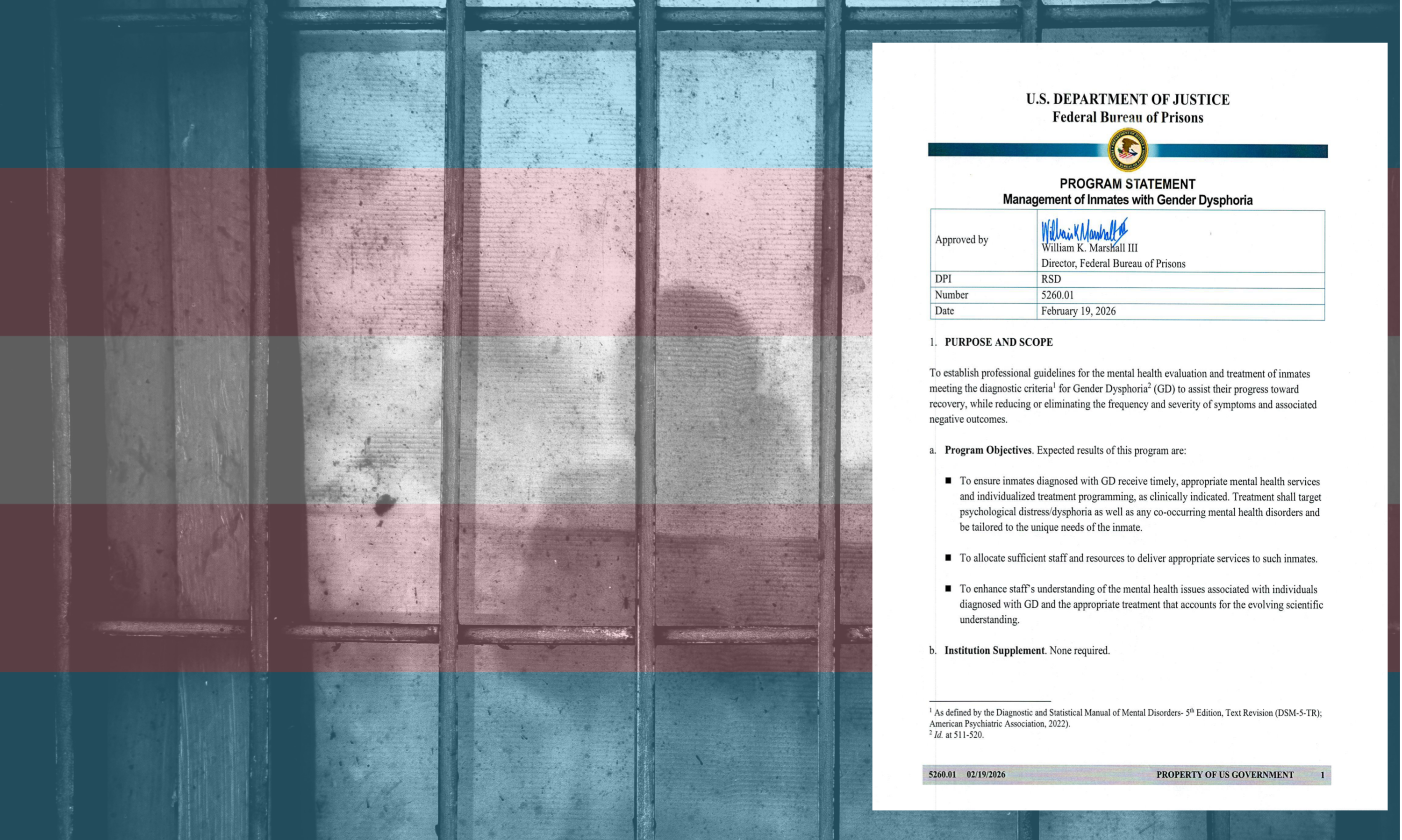
Last Thursday, the Trump administration released its new policy outlining how it will treat transgender people in Bureau of Prisons (BOP) custody. Under it, the approximately 2,200 trans people held in federal prisons will be denied access to medically necessary healthcare, subjected to constant misgendering by staff, and have all of their gender-affirming items—including binders, bras, and makeup—confiscated.
Instead, the policy will impose a treatment that targets “psychological distress/dysphoria” through “psychotherapy” (talk therapy) and “psychotropic medication” (like antidepressants) until the gender dysphoria diagnosis can be marked as “resolved.” Additionally, the new policy designates gender dysphoria as a “mental illness” that requires “routine mental health care.”
In other words, the Trump administration won’t just medically and socially detransition trans people en masse; it will actively try to ‘cure’ them of their gender dysphoria. And if this is beginning to sound like conversion therapy, that’s because it is. The BOP is giving trans people no other choice but to conform to their sex assigned at birth by forcing them into a societal role that they reject and ignoring clinical guidelines—all hallmarks of harmful and dangerous conversion practices recognized by the United Nations to be a form of torture.
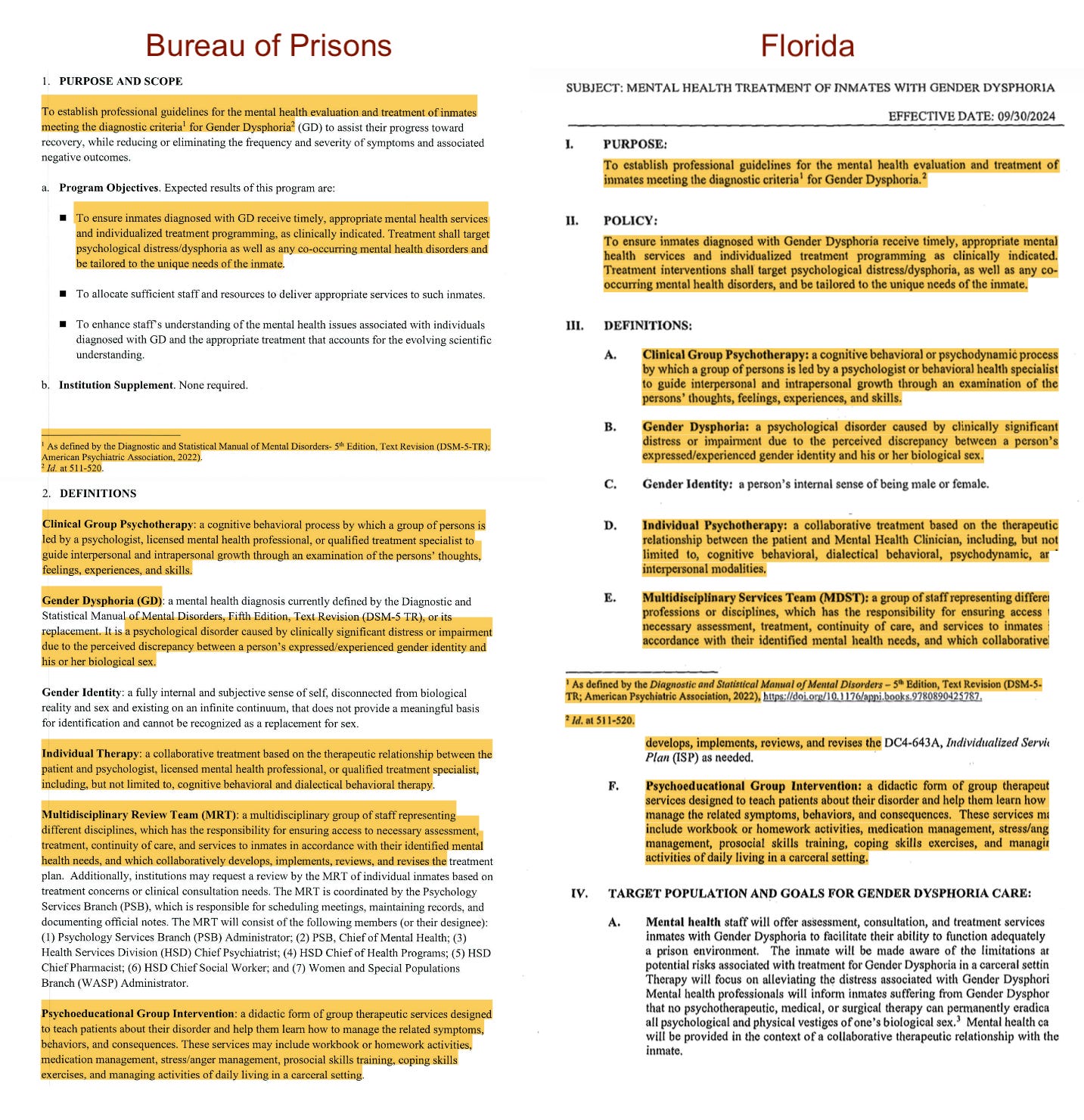
There are a few components of the policy that make this fact clear, and the first is actually that the BOP didn’t even write a large chunk of this policy. Rather, it copied significant portions of the policy that Florida implemented in September 2024—in many places word-for-word. See this comparison, with identical parts highlighted, below:
And these sections:
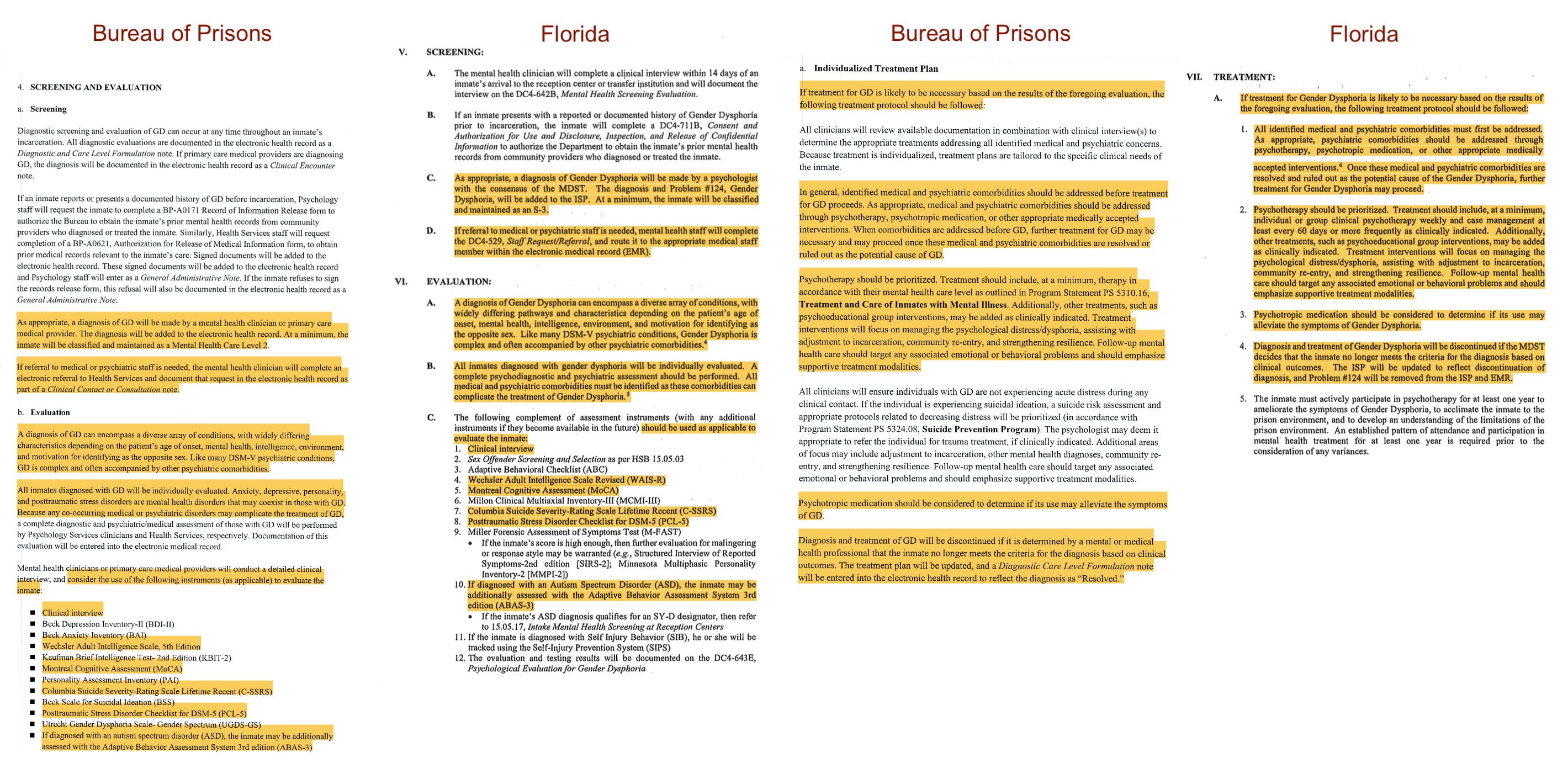
It only deviates in three key places: the purpose, the definitions, and the exceptions. In the relatively short purpose section, the BOP added language stating that it would “assist [trans people’s] progress toward recovery, while reducing or eliminating the frequency and severity of symptoms and associated negative outcomes.” Glaringly, trans people don’t “recover” from gender dysphoria—they alleviate it by socially and/or medically transitioning. Furthermore, those with gender dysphoria who do transition aren’t usually clinically designated as having “recovered,” either.
But because the policy both forcibly detransitions trans people and explicitly states that the goal of that detransition is full “recovery,” this suggests that the “negative outcome” the BOP seeks to “eliminate” is transition itself. Alarmingly, this is also the stated goal of conversion therapy.
Then, in the definitions, the Trump administration added the following terms: “Sex Trait Modification Surgeries,” “Social Accommodations,” and “Social Transition.”
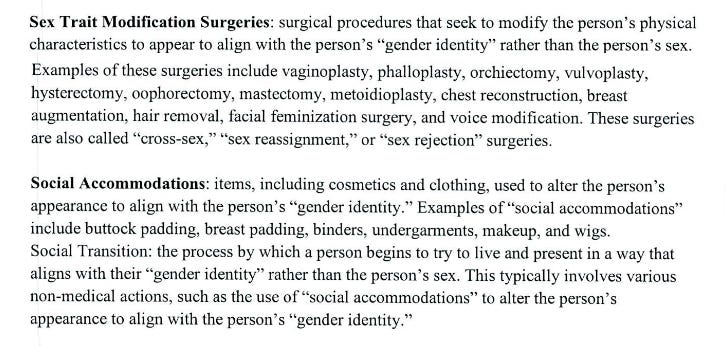
The inclusion of “sex trait modification,” which the definition asserts can also be referred to as “sex rejection,” is particularly notable. These are terms developed and, within the Trump administration, used exclusively by RFK Jr.’s Department of Health and Human Services: “sex trait modification” stems from a final rule targeting ACA coverage of trans care released last June, while “sex rejection” originates from the proposed rule that aims to weaponize Medicaid and Medicare against care for trans youth. For reference, others like Trump and the Department of Justice—which the BOP is a part of—primarily use the terms “chemical and surgical mutilation” and “transgender medical procedures.”
As such, given their presence—and especially considering that the policy goes out of its way to include “sex rejection”—it’s clear that the HHS was at least somewhat involved in crafting this policy. And that’s problematic. Since releasing its “comprehensive” review of gender-affirming care for minors, the HHS has continually asserted that “exploratory therapy”/“psychotherapy” is the best treatment for gender dysphoria, which the department claims will help it “resolve.” As organizations like the Trevor Project and KFF have stated, this conclusion is essentially conversion therapy.
Moreover, the policy explicitly states that “though Executive Order 14,168 supports [the gender-affirming care] policy, the Bureau also adopts this policy independently of Executive Order 14,168.” In other words, the BOP is claiming that the new policy is supported by medical evidence, and this means that the BOP must have consulted with a medical team when making it.
Considering that the BOP policy unnecessarily incorporates the HHS’ language and implements RFK Jr.’s ‘solution’ to gender dysphoria, and that the bureau clearly consulted with doctors, it’s likely that the medical team in question was the HHS—which, as already established, is pushing conversion therapy.
Finally, there are the exceptions. After the treatment section, the Florida policy stipulates that if the ‘treatment’ plan hasn’t worked after a year, the person may be given access to hormone therapy if necessary to comply with the Constitution’s 8th Amendment (which requires prison systems to provide necessary medical care) or a court order. It does this despite Florida having a statutory prohibition on the use of state funds for gender-affirming care.
The Trump administration’s policy goes in a different direction: it doesn’t make any exceptions. While how long the person has been on hormones and whether or not the person has had surgery factor into the length of the “tapering plan,” all trans people in federal custody will be forced off of gender-affirming care. This even applies to those that no longer produce any sex hormones of their own, something that can have devastating consequences on their health.
This isn’t the first time Trump has attacked trans prisoners, either. The day he entered office, he signed Executive Order 14168, which forced the BOP to both deny gender-affirming care to the trans people in its custody and house trans people according to their sex assigned at birth. While lawsuits have blocked Trump from enforcing these two policies, the injunction against blanket gender-affirming care denial only applies to around 800 of the ~2,200 trans people held by the BOP.
Then, back in December, it was revealed that the Department of Justice was in the process of eliminating the federal sexual violence protections for trans people in prisons, a change that impacts federal prisons as well as prison systems in the 36 states that have long tethered their policies to the DOJ’s. The Department of Homeland Security—which oversees ICE—removed similar protections in January.
Of course, it could very well be that BOP has created this policy because it knows that, under the 8th Amendment, it must provide care—however it chooses to define ‘care’—for the trans people in its custody. However, given that this is the same administration that removed rape protections for trans prisoners across the country and has repeatedly refused to treat those in ICE custody, that obligation evidently isn’t a factor in many of their actions. And considering the Trump administration’s actions against trans Americans in particular, the well-being of trans people definitely isn’t a priority to this administration.
But this is different. There’s more to this policy than just cruelty or politics. With the exception of Florida, none of the 8 other states that restrict trans prisoners’ access to gender-affirming care are known to have developed a policy after their bans went into place. In those states, transgender care ceased overnight—something that also happened when the Trump administration first began denying care last year. And while the Florida policy is horrible, it still shows some semblance of acknowledgement of the fact that the conversion therapy ‘solution’ doesn’t work and carves out state law in some circumstances.
The Trump administration’s policy, despite copying large swaths of Florida’s, does neither of these, meaning that acknowledgement was knowingly omitted. And though the policy claims its intent is for “federal funds to not be expended” on gender-affirming care, it still allows for those in custody to be tapered off of their current treatment. In other words, the policy is fine with delaying the start to the conversion therapy, but it has deliberately refused to set an end date. It’s designed to allow for no outcome other than the disappearance of the diagnosis itself.
Functionally, the policy creates a closed system in which a captive population is forcibly treated under a conversion model that has been rejected by every single major medical association in the US, denied access to medically necessary care, and explicitly assigned a measurable outcome label—“resolved.” This is essentially a human experiment—one with a sample size of 2,200. Under this policy, the Trump administration is going to subject every one of those 2,200 people to conversion therapy until it ‘works,’ until they are released, or until it breaks them. And they are given no feasible alternative: either submit or suffer alone.
And it conflicts with at least 7 of the 10 points of the Nuremberg Code, which was created in the aftermath of WWII to define the ethical boundaries of human experimentation. Even if someone views finding an alternative to gender-affirming care as a moral imperative, this policy—in subjecting a captive population to discredited, empirically harmful conversion practices—fails to meet the requirements for voluntary consent, consideration of previous results, avoidance of unnecessary suffering, risk limitation, proper safeguards against harm, freedom to withdraw, and the obligation to terminate harmful experimentation.
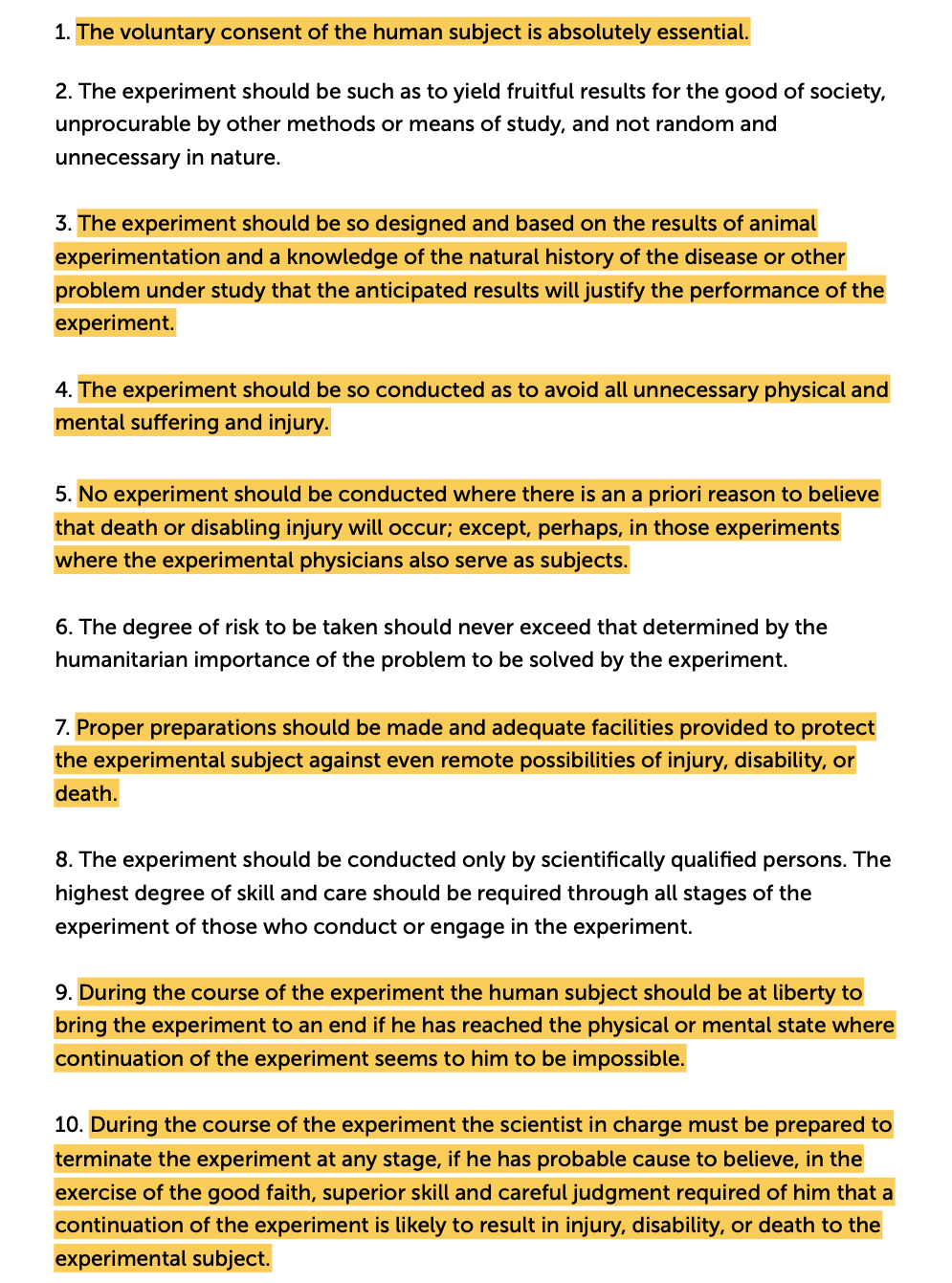
But in federal prisons, there isn’t even academic oversight. And under this policy, accepted medical guidelines are willfully ignored. Furthermore, the policy stipulates that each trans person’s outcome will be electronically recorded. Thus, if 100 of the ~800 in federal custody who have been diagnosed with gender dysphoria are marked as “resolved,” the Trump administration will be able to use that as proof that conversion therapy works. If none of those cases are “resolved,” they’ll just sweep it under the rug.
So, whether or not the administration calls it an experiment, it has constructed the infrastructure necessary to prove that the ‘treatment’ the right has spent years peddling—conversion therapy—can successfully ‘cure’ trans people. And similar to Trump’s passport policy, this is not something the administration is likely to publicly confirm absent unequivocal legal compulsion.
When rule of law erodes, prisoners’ rights are often the first target. Human experimentation on those prisoners comes not long after. It usually happens quietly, and it’s almost always been exposed when it’s too late to stop it. Historically speaking, this pattern was observed in Nazi Germany and Japan during WWII—two of the worst cases of human experimentation in modern history.
Over the past year, the Trump administration has systematically eliminated prisoners’ rights. People have been detained and deported—sometimes to countries they aren’t from—without due process. Sexual violence protections have been removed. Dozens have died in ICE custody from medical neglect. And Renée Nicole Good and Alex Pretti, who weren’t even arrested, were summarily executed in broad daylight.
Now, if the Bureau of Prisons’ policy is allowed to stand, the Trump administration is going to medically experiment on the trans people in its custody. Thousands will be subjected to a practice that has been shown to lead to an increased risk of suicidal ideation, depression, and PTSD. Over 2,000 people will be left profoundly affected by the politically motivated state-sanctioned torture the Trump administration will inflict upon them. And they alone are powerless to stop it.
Otherwise known as torture.
Thanks for the detailed report on this. I was aware of some changes being made, but the whole policy smacks of involuntary human experimentation, to prove a predetermined conclusion at any price.
When combined with the very high rate of imprisonment in the USA and the penchant for arresting and locking up anyone who is a bit “different”, particularly those now tagged “nihilistic violent extremists”, this isn’t going to end well.